Punjabi AI Voiceover Tool for Gurmukhi Text
Learn how a Punjabi AI voiceover tool turns Gurmukhi text into natural audio, what to look for, and how to use it well.

A Punjabi AI voiceover tool for Gurmukhi text turns written Punjabi in Gurmukhi script into spoken audio. In practical terms, it lets you paste or upload Punjabi text and generate clear Punjabi AI Voiceover that can be used for videos, lessons, announcements, audiobooks, and more.
If you work with Punjabi content, this matters because Gurmukhi is not just another script to “read out loud.” Good pronunciation, pause handling, and natural rhythm change the quality of the final audio. A strong punjabi text to speech system should sound usable, not mechanical, and it should handle common Punjabi phrasing without flattening the meaning.
What does a Punjabi AI voiceover tool for Gurmukhi text do?
At its core, this kind of tool converts Gurmukhi characters into audio output using speech synthesis. “Speech synthesis” simply means software creates spoken voice from text. When the text is Punjabi, the system needs to recognize Punjabi spelling patterns, sentence flow, punctuation, and the sounds associated with Gurmukhi script.
The result is a Punjabi text to audio workflow that saves time compared with recording every line manually. Instead of booking a voice artist for a quick draft, you can generate audio in minutes, review it, edit the script, and try again. For many everyday uses, that speed is the whole point.
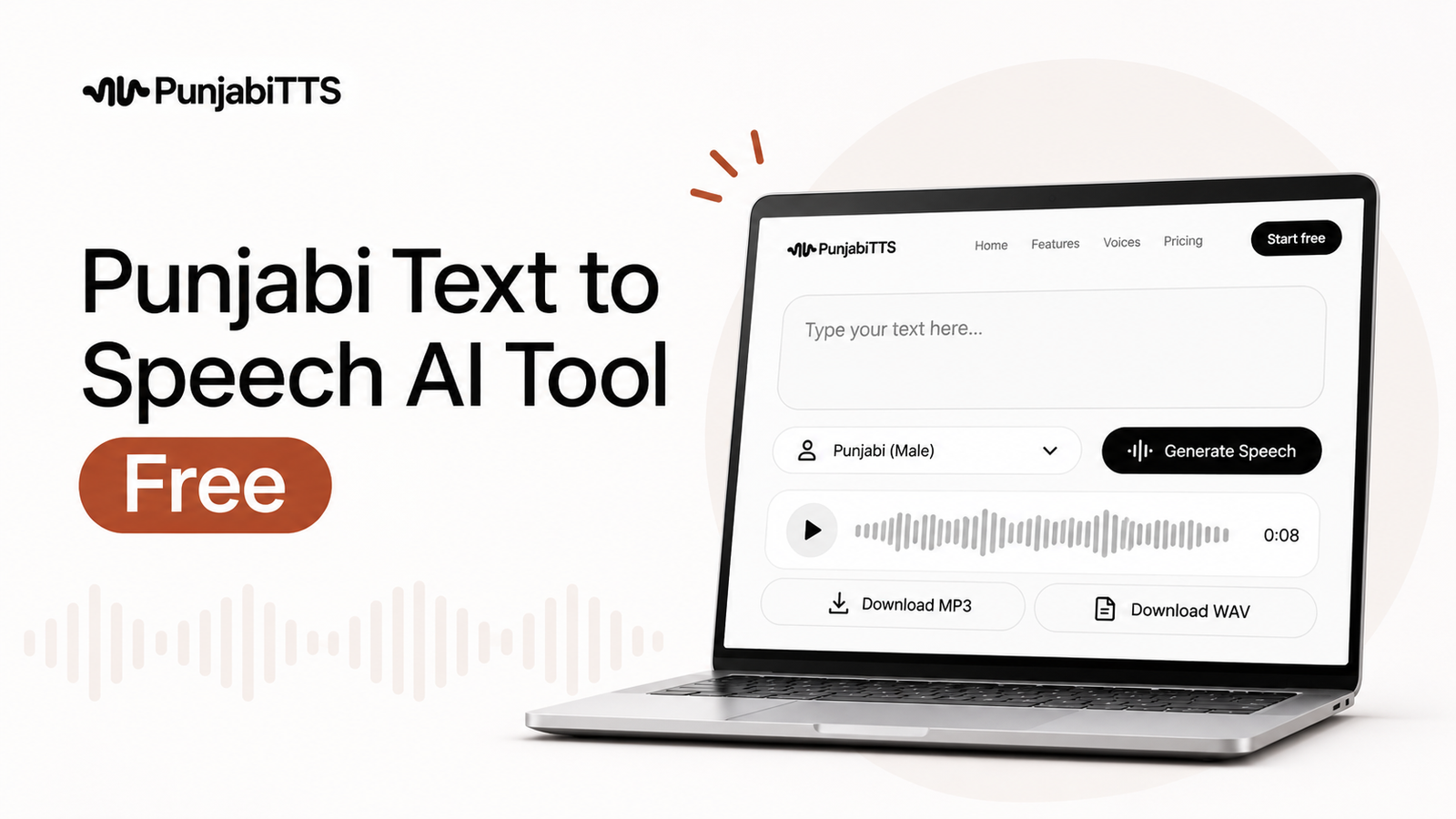
PunjabiTTS is built for this use case. It focuses on turning Punjabi text into natural-sounding speech so creators, educators, and businesses can produce voiceovers without starting from scratch each time.
Why is Gurmukhi support so important?
Punjabi audio quality depends heavily on how the text is read. A tool that only “sort of” understands Punjabi may mispronounce words, place pauses in the wrong spot, or stress the wrong syllable. That can change meaning, which is especially risky in educational, religious, or public-facing content.
Gurmukhi support matters because Punjabi is not written like English transliteration. If your audience reads and writes in Gurmukhi, the tool should work directly with that script. That means fewer workarounds, less manual romanization, and less chance of errors creeping into the final audio.
For example, a training script for customer service or a classroom lesson may include names, honorifics, place names, and familiar Punjabi phrases. A Punjabi AI Voiceover tool for Gurmukhi text should handle those with enough consistency that you can trust it for repeated use.
How does Punjabi text to speech work?
The process usually follows a simple path: you enter text, the system analyzes it, and it generates speech. Behind the scenes, a Punjabi text to speech engine maps letters and language patterns to sounds. Better tools also use language rules, punctuation cues, and voice models trained to produce smoother intonation.
1. Text input
You paste or type Punjabi in Gurmukhi. Some tools also accept text files or documents. Clean input matters because extra symbols, broken punctuation, or mixed scripts can affect the output.
2. Linguistic processing
The engine checks how words and sentences are structured. This helps it decide where to pause, how to join sounds, and how to make the spoken line feel more natural.
3. Voice rendering
The system generates the final audio file. Depending on the platform, you may hear different voice styles, speeds, or tones. The best tools aim for clarity first, then naturalness.
4. Review and export
You listen, edit the text if needed, and export the file in a format such as MP3 or WAV. That makes it easy to use the audio in editors, learning platforms, or presentation software.
Who should use Punjabi AI voiceover?
Punjabi AI Voiceover is useful for anyone who needs spoken Punjabi on a regular basis and wants a faster workflow than live recording. It is especially helpful when the same script may need multiple revisions.
Content creators
YouTube creators, short-form video editors, and social media teams can use generated audio for explainers, reels, and narrated clips. A reliable voiceover saves recording time and makes it easier to test different script versions.
Educators and trainers
Teachers, course creators, and training teams can convert lessons into audio for students who prefer listening or need repetition. This is useful for vocabulary practice, pronunciation support, and self-paced learning.
Businesses and nonprofits
Organizations often need announcements, onboarding messages, or community updates in Punjabi. A Punjabi AI voiceover tool for Gurmukhi text makes it easier to produce clear audio for internal and public communication.
Media and publishing teams
If you publish Punjabi articles, summaries, or audiobook-style content, a punjabi text to audio workflow can help extend your reach. It also supports fast turnaround when content needs to go live quickly.
What should you look for in a good Punjabi AI Voiceover tool?
Not all tools that claim Punjabi support are equally useful. Some sound stiff, while others struggle with script fidelity. When you evaluate a platform, focus on the details that affect real-world output rather than marketing language.
Accurate Gurmukhi reading
The tool should handle Punjabi script directly and read familiar words without turning them into awkward approximations. This is the first sign that the engine is actually built for Punjabi rather than lightly adapted.
Natural pacing and pauses
Good audio does more than pronounce words correctly. It needs sensible pauses after commas, periods, headings, and lists. That pacing makes the audio easier to follow and less tiring to listen to.
Voice clarity
A clear voice matters more than a dramatic one. You want speech that is understandable on a phone speaker, in a classroom, or in a car. Overly stylized voices may sound flashy at first but become hard to use in practical projects.
Editable output
The best tools let you change the script, adjust pacing, and regenerate quickly. This matters because even a good AI voice may need a small tweak for names, borrowed words, or emphasis.
File quality and export options
Look for simple export formats that fit your workflow. MP3 is useful for quick sharing; WAV is better when you want a higher-quality file for editing. A professional Punjabi AI Voiceover workflow should not trap you in a limited format.
Privacy and account control
If you are using business scripts, course material, or unpublished content, read the platform’s privacy terms. A trustworthy service should explain how your data is handled and whether your text is stored for processing or improvement.
How do you get better results from Punjabi text to audio?
Even a strong engine can produce weak audio if the input text is messy. The fastest way to improve output is to write for spoken delivery, not just for the page. That means thinking about rhythm, sentence length, and clarity.
Keep sentences clean and direct
Very long sentences often sound heavy when read aloud. Break them into shorter lines where the meaning stays clear. This helps the voice remain natural and reduces the chance of awkward pauses.
Use punctuation carefully
Commas, periods, question marks, and line breaks guide the engine. If you want a pause, punctuation usually helps more than adding random spaces. Clean punctuation is one of the easiest ways to improve Punjabi text to speech output.
Spell names and borrowed words consistently
If your script includes brand names, city names, or English terms in Punjabi text, keep them consistent. Inconsistent spelling can confuse the engine and create uneven pronunciation.
Read it out loud before generating
If the script sounds awkward to you when spoken aloud, it will likely sound awkward in the audio too. A quick human read-through catches issues that software cannot always solve by itself.
Make one change at a time
If the voice sounds wrong, adjust one thing at a time: punctuation, wording, or sentence length. That makes it easier to understand what actually improved the result.
Expert Insight: If you are preparing a script for Punjabi AI Voiceover, write it as if a person will read it slowly to a room, not as if a machine will decode every word perfectly. The cleaner the script structure, the more natural the final audio usually sounds.
What are the main use cases for Punjabi AI Voiceover?
There are many practical reasons to use a Punjabi AI Voiceover tool for Gurmukhi text. The right use case usually comes down to speed, repeatability, and the need to serve Punjabi-speaking audiences without extra recording overhead.
Video narration
For explainers, tutorials, and social posts, voiceover gives your content a more complete feel. It also makes it easier to repurpose written content into audio-friendly formats.
E-learning
Course builders can create spoken lessons, revision clips, or pronunciation guides. This is especially useful when students may want to replay a lesson more than once.
Public announcements
Community organizations and businesses can produce announcements in Punjabi for events, schedules, and instructions. A reliable voice keeps the message accessible and consistent.
Accessibility
Audio versions help people who prefer listening, have limited time, or need support consuming written content. Punjabi text to audio can be a straightforward way to widen access without rebuilding the entire content strategy.
Drafting and prototyping
Many teams use AI voiceovers first for drafts. They test how a script feels in audio form before deciding whether to keep it as AI narration or move to a human recording session.
What are the pros and cons of using AI voiceover for Punjabi?
Like any content tool, Punjabi AI voiceover has clear strengths and limits. Knowing both helps you decide when it is the right fit and when a different workflow makes more sense.
| Pros | Cons |
|---|---|
| Fast turnaround for scripts and revisions | May need editing for names, borrowed words, or special phrasing |
| Useful for repeated content, training, and drafts | May not match the emotional nuance of a skilled human voice actor |
| Easy to update when text changes | Quality depends heavily on the input script |
| Helps create audio without recording equipment | Some projects still need a human review for accuracy and tone |
For many users, the biggest advantage is control. You can edit a line and regenerate it immediately instead of rebooking a session or re-recording a file. The main limitation is that AI voice is only as strong as the engine and script quality behind it.
How is Punjabi AI Voiceover different from human narration?
Human narration and AI voiceover solve different problems. A human reader brings emotion, interpretation, and live performance choices. A Punjabi AI Voiceover tool for Gurmukhi text brings speed, consistency, and easy revisions.
Human narration is often better for emotionally sensitive work, brand storytelling, or content that depends on subtle expressive timing. AI voiceover is often better for high-volume content, quick production, and material that may change frequently.
The best decision is usually not either-or. Many teams use AI for drafts, internal training, and fast content, then reserve human narration for premium or highly polished pieces.
How should businesses choose a Punjabi text to speech platform?
When a team chooses a platform, it is not just buying a feature. It is choosing a workflow that may affect brand voice, turnaround time, and content consistency. That is why trust and usability matter so much.
Start with your real use case
Ask whether you need polished marketing audio, classroom-style narration, or simple voice drafts. A tool that is perfect for one job may be overkill or underpowered for another.
Test with your own script
Never judge a platform using only generic sample lines. Use Punjabi text you would actually publish. Include names, dates, short commands, and a few longer sentences so you can hear how the engine behaves in realistic conditions.
Check revision speed
If you expect to edit often, prioritize tools that regenerate quickly and make the process simple. The less friction between edits and playback, the easier it is to produce good results.
Pay attention to support
Even straightforward tools benefit from responsive support, especially when you are working on deadlines. A service like PunjabiTTS is valuable not just for the audio output, but for making the workflow simple enough to use with confidence.
What mistakes should you avoid?
Most bad Punjabi voiceovers are not caused by the tool alone. They come from preventable mistakes in script prep, expectations, or workflow. A little care up front can save a lot of cleanup later.
Do not paste raw, unedited text
Typos, missing punctuation, and inconsistent spelling reduce quality fast. Clean the text before generating audio.
Do not overload one line with too much information
Shorter lines are easier to process and easier for listeners to follow. If a line contains several ideas, split it.
Do not assume every voice suits every purpose
A voice that sounds good in a greeting may not work for a lesson or announcement. Match the tone to the task.
Do not skip listening to the whole file
Always review the generated audio before publishing. Small errors are easier to catch in playback than after the content has gone public.
What does a strong workflow look like?
A reliable Punjabi AI Voiceover process is simple: write clean Gurmukhi, generate the audio, review it, make quick edits, and export the file. The reason this works is that each step reduces uncertainty. You are not trying to fix everything at once.
For example, a training team can draft a Punjabi script, generate audio in PunjabiTTS, check pronunciation on a few tricky words, adjust the punctuation, and then export the final file for the lesson. That loop is faster than traditional recording and easier to repeat when the course changes later.
If you build this habit early, your team will spend less time redoing work and more time publishing useful content. That is where punjabi text to audio becomes more than a convenience—it becomes part of the production system.
Key Takeaways
- A Punjabi AI voiceover tool for Gurmukhi text turns written Punjabi into spoken audio for video, learning, business, and accessibility use cases.
- Strong Gurmukhi support matters because Punjabi pronunciation, pacing, and punctuation affect meaning and listener trust.
- The best results come from clean scripts, careful punctuation, and short revision cycles.
- AI voiceover is ideal for speed and consistency, while human narration still has an edge for emotional or premium productions.
- PunjabiTTS is a practical option when you want a focused Punjabi text to speech workflow built around Punjabi content.
Frequently Asked Questions
Can a Punjabi AI voiceover tool read Gurmukhi script directly?
Yes, a proper Punjabi AI Voiceover tool should accept Gurmukhi directly and convert it into speech without needing transliteration first. Direct script support usually gives better accuracy and a cleaner workflow.
Is Punjabi text to speech good enough for professional use?
It can be, depending on the project. For training, drafts, announcements, and many content pieces, high-quality Punjabi text to speech is often strong enough. For emotional storytelling or premium brand work, some teams still prefer human narration.
How can I improve Punjabi text to audio quality?
Use clean punctuation, keep sentences short, and remove spelling inconsistencies before generating audio. It also helps to test tricky names or borrowed words separately so you can catch issues early.
What file formats are usually best for voiceover output?
MP3 is convenient for sharing and general use, while WAV is better when you need higher-quality audio for editing. The best format depends on whether you are posting directly or doing more production work afterward.
Why should I use PunjabiTTS for Gurmukhi voiceovers?
PunjabiTTS is designed around Punjabi text to speech needs, so it is a practical choice when you want a simple way to generate Punjabi audio from Gurmukhi text. It is especially useful when clarity, speed, and a straightforward workflow matter.
If you need a dependable Punjabi AI Voiceover tool for Gurmukhi text, the main thing to look for is not just audio generation, but consistency you can build on. When the script is clean and the platform is built for Punjabi, Punjabi text to speech becomes a real production advantage. PunjabiTTS can help you turn that workflow into something repeatable, manageable, and ready for daily use.